

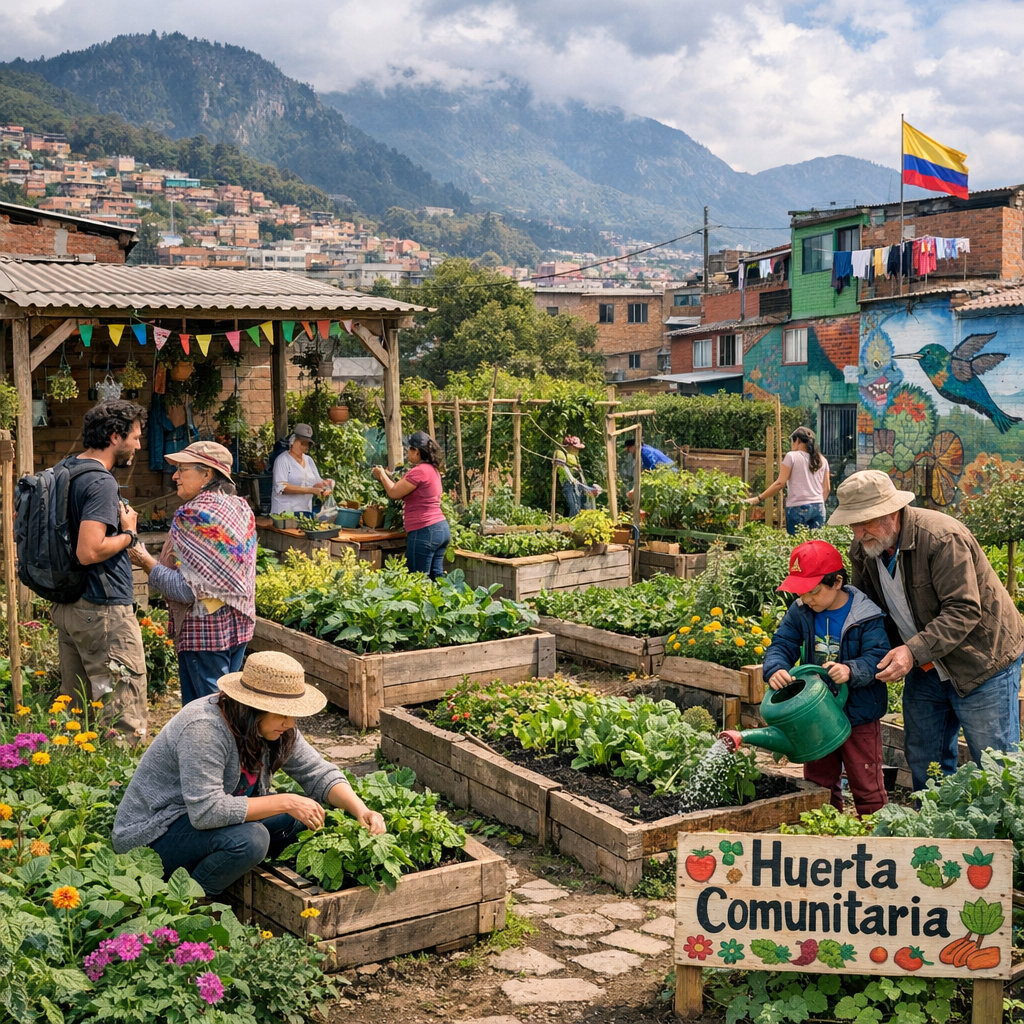
Growing up in Bogotá, I’ve seen vacant lots, overgrown corners of parks, and unused schoolyards all around me. But in recent years, many of these same spaces have been quietly transformed into something alive: huertas urbanas — community and family gardens that are taking root across our city.
What Are These Gardens Really Doing?
According to the Jardín Botánico de Bogotá, there are over 17,000 urban and peri-urban gardens strengthened, and more than 23,000 people trained, including school, family, community and institutional gardens. These don’t just grow vegetables: they sow skills, connection and environmental awareness. Resolution 361 of 2020 even formalised the use of public space for agroecological production, allowing neighborhoods to claim space in plazas, parks and sidewalks.
The Impact Beyond the Soil
Some gardens are food sources. Folks grow fresh veggies, aromatic herbs, medicinal plants—often without synthetic pesticides. Others serve as places of gathering: neighbours share work shifts, swap seeds, talk about kids and futures. In places like Kennedy and Santa Fe, gardens are helping people connect—especially seniors, young families, and migrants—turning isolated households into porous networks of support and companionship.
There’s also an economic tap: surplus produce can be sold or exchanged, compost programs use household organic waste, and seeds are traded rather than bought. It’s not always about profit—it’s about autonomy and agency. Communities are saying: “We can feed ourselves, reuse what we discard, and celebrate our land.”
Challenges: Space, Support, Sustainability
None of this happens without hurdles. Space is one: urban parcels are scarce, or small, sometimes contested. Securing legal permission to use public land requires navigating complex bureaucracy. Another is continuity: maintaining a garden takes time, water, labor, and often knowledge—especially when it comes to pest control, composting, planting cycles. Many gardens thrive when there is institutional support—technical training, seed banks, proper soil—and flounder when these supports drop away.
Voices from the Garden
I visited a community garden in Ciudad Bolívar. Doña Carmen, in her seventies, showed me her tomato plant: every morning she waters it, every weekend she picks weeds. She told me that when she started, she felt alone—retired, far from her family, spending days indoors. Now she meets people—young mothers, displaced families, neighbors she recognises—and the garden is a modest universe of purpose.
Near the Jardin Botánico, a group of students built raised beds with recycled plastic, grew leafy greens, and started selling to neighbors at small ecologic markets. For them, it’s pride: to feed yourselves, to learn things school can’t teach, and to believe your actions matter.
What We Can All Do
- Support public policy for urban agriculture: vote, advocate, track laws like the Resolution 361, demand reliable water and land access.
- Start small: a pot of herbs, a windowsill sprout—every growing thing roots us to place and people.
- Share knowledge: swap seeds, teach composting, pass along what worked or didn’t.
- Build community: garden together, invite young people and elders, bring food or tea, make it social.
In Bogotá, where cold nights and steep hills often make us feel isolated, the huertas show us something hopeful: that we can grow not just plants, but connection. That in tending one plot, we tend many.